

Connect 4 Understanding: An Innovative Couples Therapy Exercise
Kelly Walters
I used to say that I get one good, new idea a year. Perhaps it’s far less than that. But occasionally, I get a new therapy tool that can help my clients.
A few months ago, on a drive out to winterize the family lake cabin, it happened again. In a matter of seconds, I saw how couples could use the old Connect 4 game to develop better communication skills. I’m not ready to write a book about it yet, but it seems to be helping a number of marriages I have introduced it to, including my own.
It has been said that necessity is the mother of invention. Perhaps that applies here as well. I spend way too many hours outside of the office, trying to solve the many issues that counseling presents.
One of the greatest challenges is to help married couples break old negative communication patterns that too often escalate from small disagreements to unhealthy anger and more damage. In his book, Love and Respect, Emerson Eggerichs named this spiraling pattern the “crazy cycle.” Once it starts, the rest of the conversation is like a runaway train, running downhill with one hundred cars and no brakes.
We can so easily do damage with what we say to each other. As it says in the book of James, “…Consider what a great forest is set on fire by a small spark. The tongue is also a fire, a world of evil…” (James 3:5-6, NIV)
I have tried many methods to help couples learn how to become better listeners and work toward understanding rather than “victory at all costs.” It is often difficult to avoid defensiveness, especially if there have been many layers of hurt. Rather than validating each other, it is more natural to respond, “But I think…!”
 Unfortunately, this does not help your spouse feel heard or understood. Instead, it often comes across as dismissive and disrespectful. And so it goes back and forth till both of you are fully triggered and out of control.
In discussing some unhealthy patterns in his own otherwise-healthy marriage, my pastor told me, “I think we just need to slow down.”
I might have been considering one of those client conversations, wondering how I could get them to exchange their thoughts or feelings more gently, when my wandering brain thought of yellow and red game pieces from Connect 4.
In a sudden moment of inspiration, like Archimedes shouting “Eureka!” from his bathtub, I knew I had discovered something golden. I couldn’t wait to try it out with a couple that argues. Fortunately, I didn’t have to go far. My wife was right next to me. So, I explained the idea, and she thought it might be good. I have learned that if she thinks an idea of mine is good, then it must be!
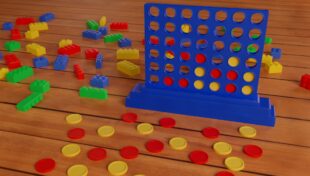
For those who have forgotten: Connect 4 is where players take turns dropping their red or yellow pieces into a choice of vertical columns in a plastic rack. As the pieces stack up, the goal is to get four of your color in a row horizontally, vertically, or diagonally.
Sorry to inform those who were excited to play the actual game, but all we need the game for is to borrow the pieces. You could easily substitute checker pieces or poker chips.
Here is the basic explanation.
Connect 4 Understanding
Level 1 – Considering each other’s thoughts and feelings
- Each spouse needs to grab a large handful of red and yellow game pieces.
- The red pieces, since they are the color of hearts, represent our feelings. Or you can remember that when someone “sees red,” he/she is angry.
- The yellow pieces represent thoughts. Think of the well-known metaphor of a light bulb over someone’s head when they have a “bright” idea.
- Whenever one of you shares a thought or feeling, you must also place a colored game piece out on a visual spot to represent and display that idea. The concept is that you are not “owning” it but putting it out there like laying your cards on the table.
- Next comes the most important part of this game. Before responding, the “listening spouse” must pick up the piece just played to demonstrate that they are considering what had been said. As they hold the piece, they reflect on what was shared by paraphrasing, empathizing, or even just repeating what they heard.
 The goal here is for them to check to see if they clearly understand what the chip represents and to validate their spouse, who just shared. Even if they don’t agree, taking the time to carefully ponder what was said communicates respect. Most of us don’t expect that others will always agree with us, but we at least want them to listen and think about it for a moment.
- After one partner shares, the other takes a turn. The same practice of placing a chip on the table as well as a thoughtful response from the listening partner, is repeated. The response can be a thought (yellow) or a feeling (red) chip. It could even be both. The important thing is getting ideas out on the table.
- In this way, the couple continues to exchange thoughts and feelings back and forth till each feels understood.
- Throughout this stage, it is important that neither spouse tries to jump to a solution or convince the other to change their mind. The goal is to practice good listening and respectful sharing.
Level 2 – Looking For a Solution or Compromise
When level 1 has been done well enough for each spouse to generally feel understood and supported, they can attempt Level 2. Level 2 is all about the couple trying to find a solution that can be mutually agreed upon.
The big idea is to address and include the thoughts and feelings of both partners. A way to symbolize this is to stack chips together on the table. Not all chips have to be included. It also doesn’t matter which chip represents which idea. The goal is just to produce one or more proposals that contain some level of consensus.
This could lead to some suggested solutions that include these ideas.
A sample solution to a discussion about money might look like this:
“We both agree money is tight right now.” (yellow chips)
“You get frustrated that our house carpet is so old and dirty.” (red chip)
“I get worried that we have little in savings to cover an emergency.” (red and yellow chips)
“We should have a chunk of money coming in for our tax return.” (yellow chip).
“So, I have a thought…What if we take half of the money coming in and put it in the emergency savings account? We take the other half and look into some new carpet? Even if it won’t do all of it, we can at least do some.” (stacking some, though not all, of the chips on the table together)
“I like that idea,” your spouse says, (adding a red chip to the stack)
Level 3 – Diffusing Runaway Argument
 Many of the above suggestions sound simple. They are. A couple would do well to practice something like this, whether you use game pieces to structure the conversation or not. However, just because they are simple doesn’t mean that these practices are always easy.
What do you do when you are already in an argument that is quickly heading in the wrong direction? This is what level 3 is for.
As soon as you realize that the discussion is becoming unproductive and emotional, ask for a pause. Say something like this:
“Hey, can we take a pause and try something different for a few minutes? We have been going back and forth, pointing out the many ways in which we disagree.”
“Instead, let’s take a breath and go back to some of the things that we do agree on.”
At this point, it might be helpful to get out the yellow and red game pieces. Or, like my wife did this morning, grab some object nearby to place on a table. In this case, she held up a drink coaster as she shared and then gave one to me.
Sharing three or four things you agree about regarding the topic discussed should change the temperature and tone of the conversation. This will likely help you see that the two of you may not be that far away from consensus.
 If there is still too much tension, you might suggest another time to come back and discuss the issue. We often get greater insight after we have put the argument on the shelf for a while. If you are both eager to finish, wade back into the issue again, intent on listening and sharing more respectfully this time.
For more help navigating through a difficult season in your marriage or other life issues, contact me or any of the other counselors at Spokane Christian Counseling. We also have sister offices elsewhere. We can partner with you in your quest to grow and thrive.
Photos:
“Connect 4”, Courtesy of Hawksky, Pexels.com, CC0 License; “Argument”, Courtesy of Timur Weber, Pexels.com, CC0 License; “Coffee”, Courtesy of Mike Jones, Pexels.com, CC0 License; “Couple on a Couch”, Courtesy of Timur Weber, Pexels.com, CC0 License